The cost of a common blood test can vary by more than 5,000%
The exact same test can cost you $13 or $800. Nothing about the blood changes. Only the paperwork does.
Here is a fact that should be simpler than it is: there is no such thing as "the price" of a blood test. A cholesterol panel is a cholesterol panel. The lab runs the same machine on the same tube of blood no matter who you are. And yet, depending on where you get it and whether your insurance decides to pay, that one panel can cost you anywhere from about $13 to $800. Same test. Same result. A price that swings by nearly 6,000%.
I went through 16 of the most commonly ordered blood tests and pulled three numbers for each: what Medicare pays to run it (roughly what it actually costs), the cheapest cash price you can just buy it for online, and the top of the range a hospital will bill you if things go sideways. Every single test varied by at least 2,603%. The worst, a plain glucose test, varied by 7,534%, mostly because the thing costs almost nothing to actually run. Here is the whole mess in one chart.
What eight common blood tests actually cost
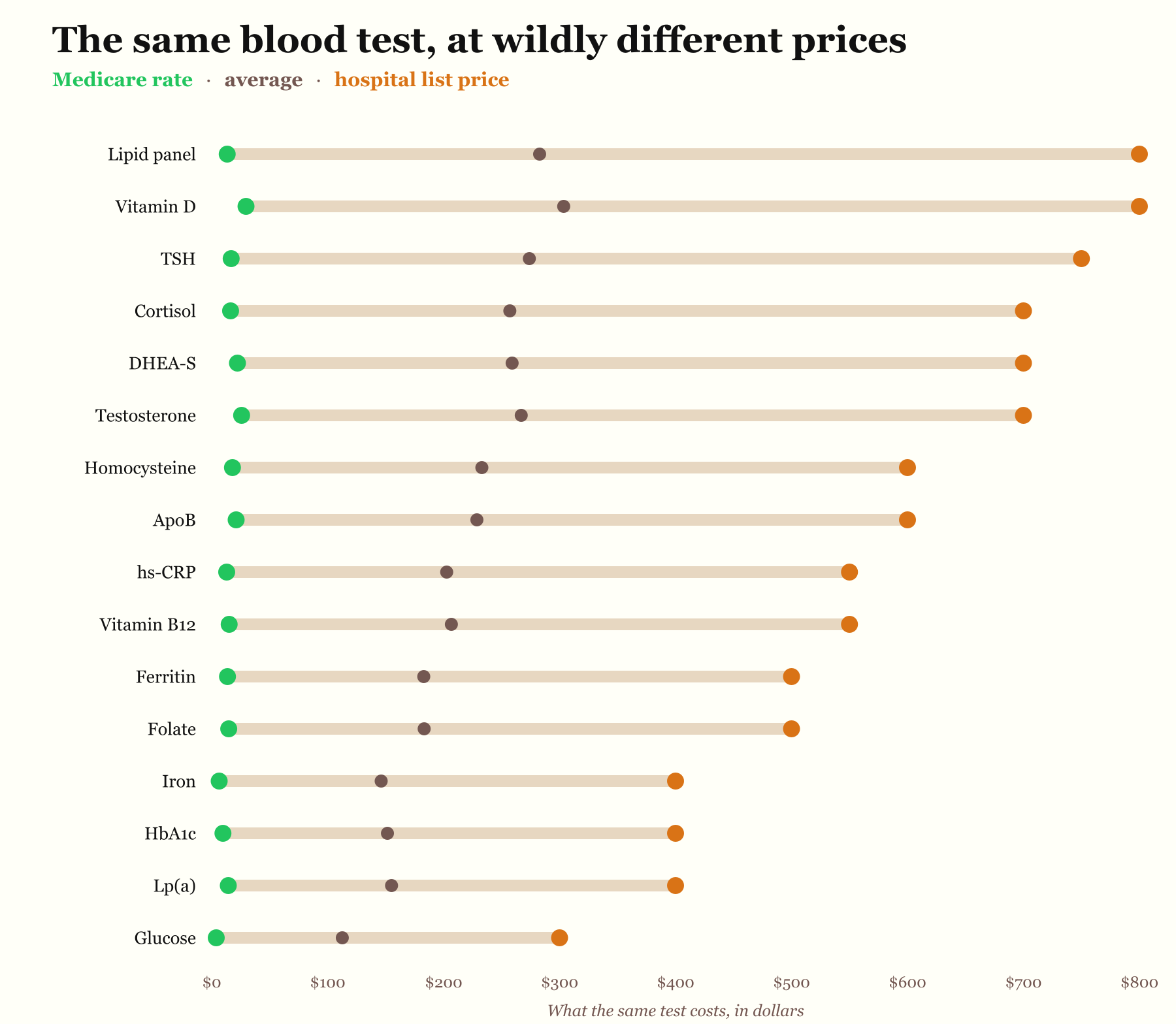
| Blood test | Min Medicare | Cash DTC lab | Max Hospital | Average | Variation |
|---|---|---|---|---|---|
| Lipid panel (LDL, HDL, cholesterol, triglycerides) | $13.39 | $35 | $800 | $283 | 60x |
| Vitamin D | $29.60 | $81 | $800 | $304 | 27x |
| TSH (thyroid) | $16.80 | $55 | $750 | $274 | 45x |
| Cortisol | $16.30 | $55 | $700 | $257 | 43x |
| DHEA-Sulfate | $22.23 | $55 | $700 | $259 | 31x |
| Testosterone | $25.81 | $75 | $700 | $267 | 27x |
| Homocysteine | $17.92 | $81 | $600 | $233 | 33x |
| ApoB (Apolipoprotein B) | $21.09 | $65 | $600 | $229 | 28x |
| hs-CRP (inflammation) | $12.95 | $45 | $550 | $203 | 42x |
| Vitamin B12 | $15.08 | $55 | $550 | $207 | 36x |
| Ferritin | $13.63 | $35 | $500 | $183 | 37x |
| Folate | $14.70 | $35 | $500 | $183 | 34x |
| Iron (serum) | $6.47 | $32 | $400 | $146 | 62x |
| Hemoglobin A1c | $9.71 | $45 | $400 | $152 | 41x |
| Lp(a) | $14.32 | $51 | $400 | $155 | 28x |
| Glucose (fasting) | $3.93 | $34 | $300 | $113 | 76x |
Min = the 2026 Medicare Clinical Laboratory Fee Schedule national rate. Cash = the cheapest all-in direct-to-consumer price we track (list price plus a $6 physician fee). Max = the high end of the typical hospital chargemaster range. Variation = max ÷ min. The four lipid markers are shown as one row because they are ordered, priced, and billed together as CPT 80061.
The most absurd examples
Start with the one that should be simplest. A glucose test, among the most ordered in all of medicine, costs Medicare $3.93. Four dollars. You can buy it yourself for about $34. And a hospital can bill you up to $300 for it, a 76x spread, or 7,534%. The cheaper a test is to actually run, the more unhinged the markup gets, because there is no real floor holding the top number down.
The lipid panel, the cholesterol test doctors order almost reflexively, tells the same story at a larger scale. Medicare pays $13.39. You can buy it yourself online for about $35. Walk into a hospital outpatient lab without the right paperwork and the billed charge can reach $800. Same tube of blood, a 60x range on the number.
Vitamin D is the one that gets people. It costs Medicare $29.60. It is one of the most requested tests in the country. And because the U.S. Preventive Services Task Force says there is not enough evidence to screen for it routinely, insurers love to deny it, which means you can be handed a hospital bill up to $800 for a nutrient test that costs less than a movie ticket to actually perform.
Then there are the advanced heart tests, ApoB and Lp(a), which the newest cardiology guidelines increasingly recommend. Medicare pays around $21.09 and $14.32 respectively. Because they are not yet routine screening, they are often flat-out denied for asymptomatic people, and the hospital charge can run $600 and $400. The tests your doctor is now telling you that you should get are precisely the ones your insurer is most likely to refuse.
And the maddening part is that even the least variable test on this list still swings 27x, a 2,603% gap between what it costs and what you can be charged. There is no well-behaved category here. The floor is always a few dollars and the ceiling is always in the hundreds.
Why one test has a dozen prices
None of this is an accident, and none of it is really about the blood. It is about four completely different pricing systems sitting on top of the same lab result, none of which talk to each other.
1. What it actually costs. The Medicare Clinical Laboratory Fee Schedule is the closest thing we have to a true price. It is what the largest single payer in the country has decided a test is worth, and for most common markers it lands between about $4 and $30. These rates were frozen at 2020 levels under PAMA and have been repeatedly kept there by Congress, so they barely move. This is the number to keep in your head: a lipid panel costs the system roughly $13.39.
2. The cash price. Direct-to-consumer labs like Quest's own site and Walk-In Lab will sell you most of these tests outright, no doctor visit required, for a posted price you can see before you buy. It is usually two to four times the Medicare rate, which is a markup, but it is a knowable, honest number printed on a webpage. In a sane market this would be the whole story.
3. The secret negotiated rate. If you have insurance and the test is covered, your plan pays some rate it privately negotiated with the lab. You almost never get to see this number before the fact. It varies by insurer, by contract, by facility, and it is the reason two people in the same waiting room can be charged different amounts for the identical draw.
4. The chargemaster fantasy. Every hospital keeps a master list of prices called the chargemaster, and the numbers on it bear almost no relationship to cost. This is where the $800 lipid panel lives. Nobody with good in-network coverage pays it, but if you are uninsured, out of network, or your test gets denied, this is the bill that shows up. The chargemaster is a fictional starting point that only becomes real for the people least able to fight it.
Layered on top is coverage roulette. Whether insurance pays at all depends on how the test is coded. Screening tests recommended with a high grade (the lipid panel, HbA1c) are covered at $0. Tests ordered for a diagnosed condition are usually covered with a copay. But tests deemed "not proven for screening," including ApoB, Lp(a), vitamin D, and homocysteine, get routinely denied when you are healthy and just want to know your numbers. Denial is the trapdoor: the moment your claim bounces, you fall from the $13 world straight into the $800 one.
We are supposed to have fixed this. The federal Hospital Price Transparency rule took effect in 2021 and requires hospitals to publish their prices, and the No Surprises Act was meant to shield patients from exactly these blindside bills. In practice, compliance is patchy, the published files are nearly unreadable, and the average person ordering a cholesterol test still has no realistic way to know what they will be charged until the bill arrives. The information exists. It is just kept in a form engineered to be useless to you.
What you can actually do about it
You cannot fix the system before your next blood draw, but you can route around the worst of it. Three practical moves:
- Know the cash price before you go. For most common markers, the posted direct-to-consumer price is both the most predictable number and often cheaper than what a hospital lab would bill an uninsured patient. It removes the roulette entirely. Our blood test directory lists the cheapest standalone price for each marker.
- Ask where the blood is drawn. The same order sent to an independent lab (Quest, LabCorp) usually costs a fraction of what a hospital outpatient lab charges. If your doctor writes the order, you can often choose the draw site.
- Watch out for the denial-prone tests. If you want ApoB, Lp(a), vitamin D, or homocysteine as a healthy person, assume insurance may not cover it, and price the cash option first so a denial does not turn into a hospital bill.
If you would rather get the full picture in one shot, a comprehensive panel from a service like Function Health or Superpower bundles a hundred-plus of these markers into a single flat price, which is its own way of escaping the per-test pricing chaos. But for a handful of specific tests, knowing the numbers above is usually enough to keep a $13 test from turning into an $800 one.